
Contents:
- What is AI solution research?
- How the Research Agent works
- AI suggestions from the market: where the results come from
- AI suggestions from the internal Portfolio: which data is used
- What you get as a result
- Why not just use Google or ChatGPT?
- How to get precise results
- Frequently asked questions
1. What is AI solution research?
AI solution research (the Research Agent) works like a colleague who researches, compares and prepares a recommendation for you. Stackgini combines the strengths of search engines (current and broad) with those of AI models (understanding, evaluating, explaining).
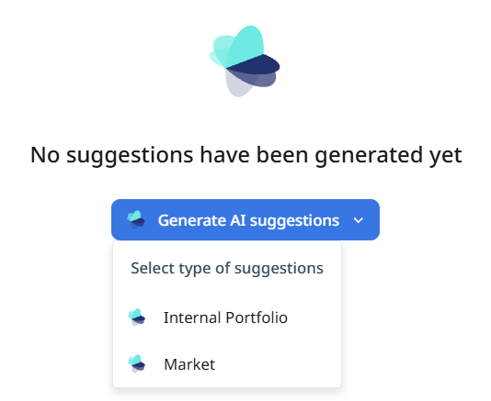
In your initiative you start both from the AI Suggestions button. There you select the type of suggestions:
- AI suggestions from the market: Which solution on the market fits our needs? The search covers the Stackgini database and a live web search. This can take up to an hour.
- AI suggestions from the internal Portfolio: Do we already have an application that covers the need? The search covers only your portfolio and usually takes a few minutes. It is worth running before every new purchase to avoid duplicates.
The difference between portfolio applications and applications from the market is explained in our article: Portfolio-Applikationen Vs. Applikationen Aus Dem Stackgini Katalog (Markt)
2. How the Research Agent works
The agent works in four steps, from understanding your organization to delivering the finished shortlist.
- Understands your organization. It uses your company profile and your existing software to identify what fits your size, industry and region.
- Determines the need. It translates your initiative into use cases and derives knockout criteria from your must-have requirements. The result is a description of the ideal solution, against which every solution is measured.
- Searches the market or your portfolio, depending on the type of suggestions. The search works by meaning, not by keywords. A solution is found even if its description uses different terms than your initiative.
- Filters and evaluates in several stages. Solutions that fail a knockout criterion are removed. The rest are evaluated for fit and weighed against each other. Every inclusion and every exclusion comes with a reason.
How the individual AI suggestions are calculated and what the icons mean is explained in our article: How Do I Interpret The AI Suggestions With AI Assessments?
3. AI suggestions from the market: where the results come from
AI suggestions from the market draw on two sources: the Stackgini database and a live web search that runs with every new search in the market.
Source 1: Stackgini database
- Stackgini's own data, which the AI queries first: market knowledge on tens of thousands of solutions on the market, product documentation, user guides, user manuals, admin guides, help pages and providers' knowledge bases
- Provider contacts for RfI processes
Source 2: Live web search
- With every new search in the market, the agent searches the web live for solutions. The research is therefore not limited to the Stackgini database, but covers the market that can be found on the internet at the time of the research.
- All established sources in view, including Google, Gartner, TechCrunch and G2.
- Newly found solutions are added to the Stackgini database while your initiative is still running, prepared and evaluated like any other solution. In the background, Stackgini automatically makes sure that all information available from the provider is indexed and made available to the AI, for example product documentation, user guides, user manuals, admin guides, help pages and knowledge bases. After that, they are available in all future initiatives. The Stackgini database grows with every search in the market.
4. AI suggestions from the internal Portfolio: which data is used
AI suggestions from the internal Portfolio search only your portfolio, without a live web search. They compare your need with everything that is known about your applications.
For each application, this data is used:
- The application's Description from the General Information tab
- Knowledge Library: the tab where all the knowledge recorded for an application comes together. Every source has a Type:
- Application Knowledge: the market knowledge from the Stackgini database that is linked to the application
- File: your own documents that you have uploaded, for example for custom-built applications
- Web URL: your own web sources that you have added
- Category: a linked software category
- Third Party Integrations: Business Capabilities from SAP LeanIX, if the integration is set up (Set up SAP LeanIX integration). They sit in a separate table under Knowledge Library.
These signals are taken into account as well:
- Lifecycle: Deleted applications and applications at the end of their lifecycle are filtered out in advance.
- Preferred providers: Applications from preferred providers get a slight advantage, but no free pass.
- Product families: Multiple entries of the same product family are counted only once.
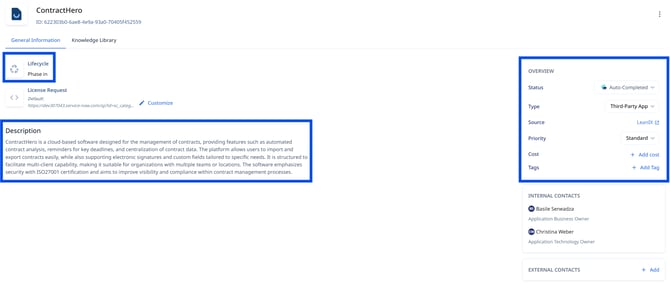
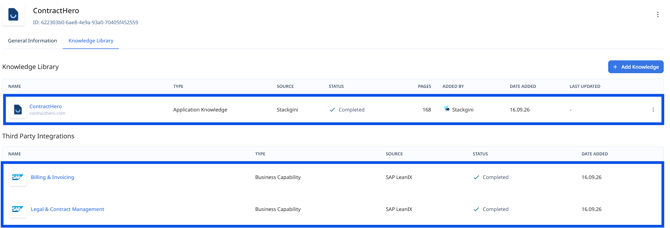
Two principles apply:
- Missing information is not a reason for exclusion. If something is not recorded for an application, it is assessed more cautiously, but not filtered out. An application is only excluded if it clearly conflicts with a must-have requirement.
- Platforms count for their usual purposes. A platform on which you would first have to build the solution yourself does not count as a match.
5. What you get as a result
You get a basis for a decision, not a working list: only the solutions that really fit, each with a reason and a use-case-by-use-case comparison.
- The number is a result, not a target. The shortlist contains as many solutions as actually fit. It is never padded with near misses.
- Each application is measured against the need, not against the others. A large portfolio does not push a fitting tool down the list.
- "Nothing suitable in the portfolio" is a valid result. It shows you that a search in the market is worthwhile. Partially fitting applications are still shown.
What the AI Assessments and their icons mean is explained in our article: How Do I Interpret The AI Suggestions With AI Assessments?
6. Why not just use Google or ChatGPT?
Search engines deliver raw results, general AI models deliver answers without sources. AI solution research combines a proprietary, structured database with current data from Stackgini, from the web and from your organization's internal knowledge sources.
| Search engine | ChatGPT, CoPilot, Perplexity & Co. | Stackgini AI solution research | |
|---|---|---|---|
| Data basis | Public websites | Training data + live web search Access to web-optimized websites only |
Internal company documentation plus the Stackgini database with market knowledge and product documentation, plus live web search. Access to web-optimized and non-optimized websites (including JavaScript-rendered pages, for example), because product documentation often sits there |
| Timeliness | Current | Partly current when a web search runs, but often dependent on training data that may be outdated | Current: live web search with every new search in the market |
| Neutrality | Paid ads, SEO bias | Biased by Generative Engine Optimization (GEO), ads in part | No ads, no bias |
| Transparency | Individual hits without context | Partial source transparency | Full source transparency. A reason for every inclusion and exclusion |
| Depth | Raw results | General assessment | Evaluation per requirement and use case |
| Next step | Manual analysis | Export of results into local file formats | Embedded in your organization's governance process. For example provider contact directly on the platform, or a decision template with approvals in one click |
7. How to get precise results
The quality of the results depends mainly on your input. The more clearly your use cases and must-have requirements are written, the more precise the shortlist.
- Keep the scope in check: 8 to 12 use cases with up to 10 requirements each have proven effective.
- Write requirements clearly: How Do I Formulate Requirements Correctly? and Typical Stumbling Blocks In The Creation Of Requirements
- Read AI evaluations and question marks correctly: How Do I Interpret The AI Assessments Of The Requirements?
- Clarify open points directly with the provider: How Do I Contact Providers?
Important: AI solution research delivers a well-founded preselection. You make the decision, and you can add your own internal evaluations at any time.
8. Frequently asked questions
Why does a well-known solution have a low match score?
The score measures fit with your initiative, not how well known a solution is. Why purely AI-based evaluations are often lower is explained in How Do I Interpret The AI Assessments Of The Requirements?
Why doesn't an application from my portfolio appear?
Deleted applications and applications at the end of their lifecycle are not considered. Otherwise, the application does not fit the need closely enough.
How do I find a specific solution or all solutions in a category?
Use the manual solution search: How Do I Use The Manual Solution Search?
Can I show only open-source solutions?
Not exclusively, but you can have open source taken into account. AI solution research uses all the information in your initiative. So add your preference for open source everywhere it fits: in the initiative overview, in the problem description, and in your use cases or in your non-functional requirements (for example as a separate must-have requirement).
Is my data used to train AI models?
No. The tenant is strictly separated, and data inside a tenant is never used across tenants.